By Caroline Nassuuna
ICPAU
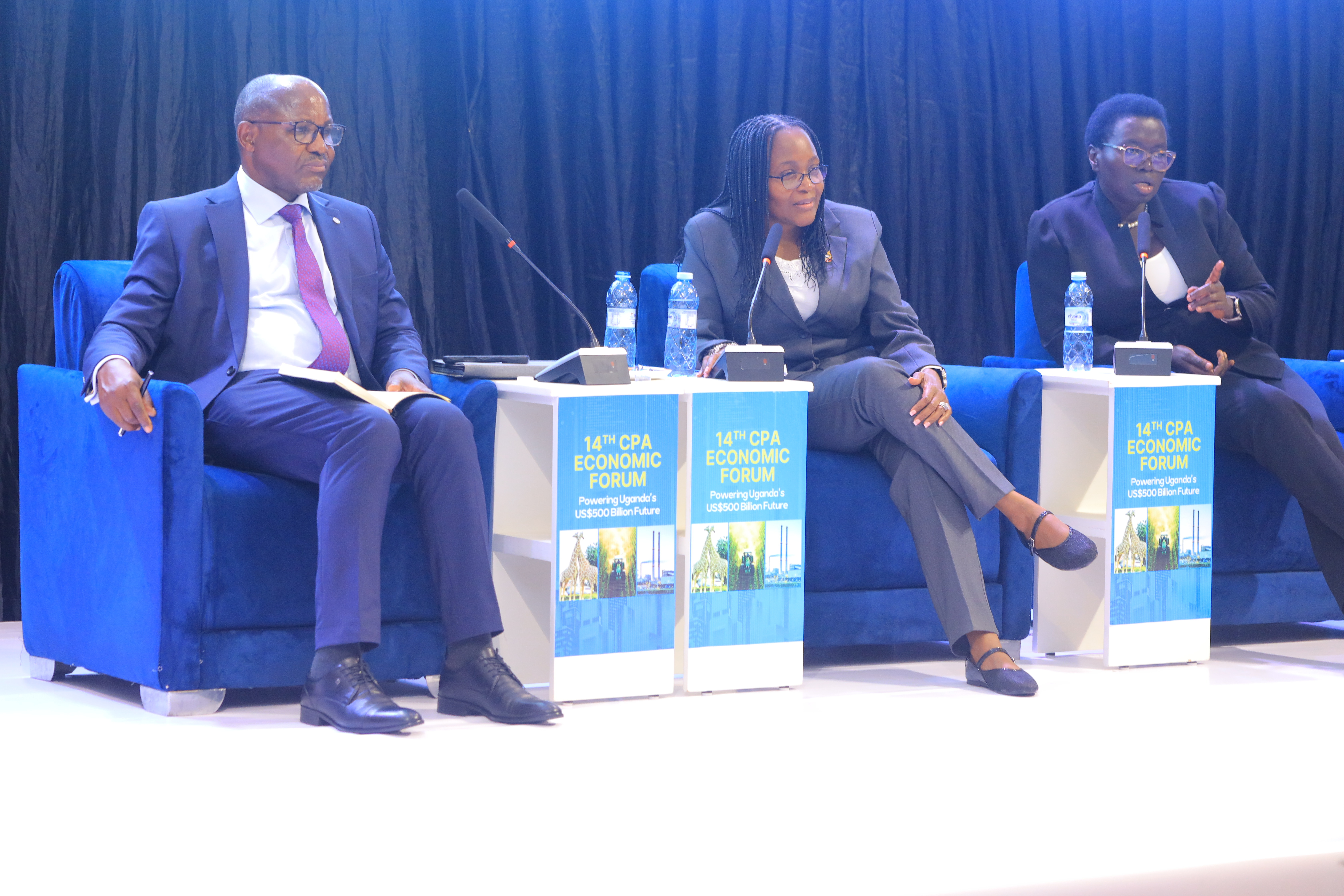
Economists gathering at the 14th CPA Economic Forum have advised that Uganda's ambition to grow its economy to US$500 billion by 2040 will not be achieved by the government or business working in isolation.
According to them, achieving tenfold growth requires a partnership in which the public sector creates the conditions for growth, while the private sector generates the innovation, investment, jobs and taxes that sustain economic transformation.
These discussions were generated from a presentation on growing returns from business enterprises: Insights from the public and private sector, delivered by CPA Fabian Kasi – Centenary Group and Proscovia Nabbanja – Executive Director, Uganda National Oil Company (UNOC).
Representing the public sector perspective, Nabbanja illustrated how strategic state enterprises can anchor national development by unlocking entire value chains rather than merely extracting natural resources.
“Oil and gas should not simply be viewed as a source of crude exports but as the foundation for a wide industrial ecosystem encompassing refining, petrochemicals, fertiliser production, plastics, logistics, construction, storage, manufacturing and regional trade. Through investments in the refinery, the East African Crude Oil Pipeline, storage terminals and the Kabale Industrial Park, Uganda is positioning itself to create industries that will continue generating value long after the first barrel of oil is produced,” noted Nabbanja.
She further noted that people are the engine of industrialisation. The oil and gas sector has already created various jobs, with Ugandans increasingly occupying them. More than 14,000 Ugandans have received specialised training, while thousands of local companies have been integrated into the sector through procurement opportunities and joint ventures with international firms.
On the other hand, CPA Kasi discussed the private sector's role in powering Uganda's transformation. He noted that economic growth begins with profitable businesses.
“When enterprises generate healthy returns, they reinvest, expand production, employ more people, strengthen supplier networks and ultimately pay more taxes. These taxes, in turn, give government the fiscal space needed to invest in its priority sectors,” noted CPA Kasi.
Rather than focusing solely on increasing tax rates, CPA Kasi argued that policymakers should first enable businesses to grow, allowing tax revenues to increase naturally through expansion, formalisation and improved compliance.
Using the current national budget as an illustration, CPA Kasi observed that government has allocated over UGX 4.4 trillion to the Agro-industrialisation, Tourism development, Mineral-based industrialisation, and Science, technology, and innovation (ATMS) sectors, signalling their importance in Uganda's development agenda. However, public investment alone is insufficient.
He advised that these allocations should be used to crowd in private investment by aligning infrastructure, credit, taxation and policy incentives with strategic value chains capable of generating higher returns and exports.
Policymakers were advised to rethink taxation, noting that sustainable revenue mobilisation comes from widening the tax base rather than increasing the burden on compliant businesses. Simplified tax administration and rationalised tax exemptions would create a healthier business environment that encourages investment while increasing government revenues over time.
In addition, stable regulatory frameworks also reduce uncertainty, making Uganda a more attractive destination for investors.
The 14th CPA Economic Forum is organised by the Institute of Certified Public Accountants of Uganda (ICPAU) and is being held from 15 to 17 July 2026 under the theme Powering Uganda’s US$ 500 Billion Future.
Partnering organisations are National Identification and Registration Authority (NIRA), Uganda National Oil Company (UNOC), The Electoral Commission, The Micro Finance Support Centre, PKF Uganda, Ernst & Young, National Water & Sewerage Corporation (NWSC), Electricity Regulatory Authority (ERA), Centenary Bank, Insurance Regulatory Authority (IRA), Uganda Retirement Benefits Regulatory Authority (URBRA) and Roofings.
END